














If you import HVAC equipment or components, the tariff ground under your pricing has moved twice in the last six months, and not in the direction most buyers expected. In February 2026 the Supreme Court ruled that the president could not impose a broad import surcharge under the International Emergency Economic Powers Act, and in its place the U.S. Trade Representative pivoted to other authorities. The reporting that surfaced this issue for HVAC buyers is blunt: new Section 301 duties now place 10% to 12.5% on 60 countries, and that can push imported equipment and component costs higher.
Here is the trap. The court decision felt like relief, but the tariffs that actually punish HVAC never went away. The industry runs on steel, aluminum and copper, and those sit under a different legal authority that the ruling did not touch. So the real question is not "are HVAC import tariffs going up or down?" It is "exactly where is my exposure, and how do I rebuild my landed cost model to reflect it?"
This guide walks through the current tariff picture, how to trace exposure from a finished system down to its major components, and how to update your landed cost model by country and HTS code so you can decide whether to shift assembly, swap suppliers or redesign your bill of materials.
What Actually Changed (and What Didn't)
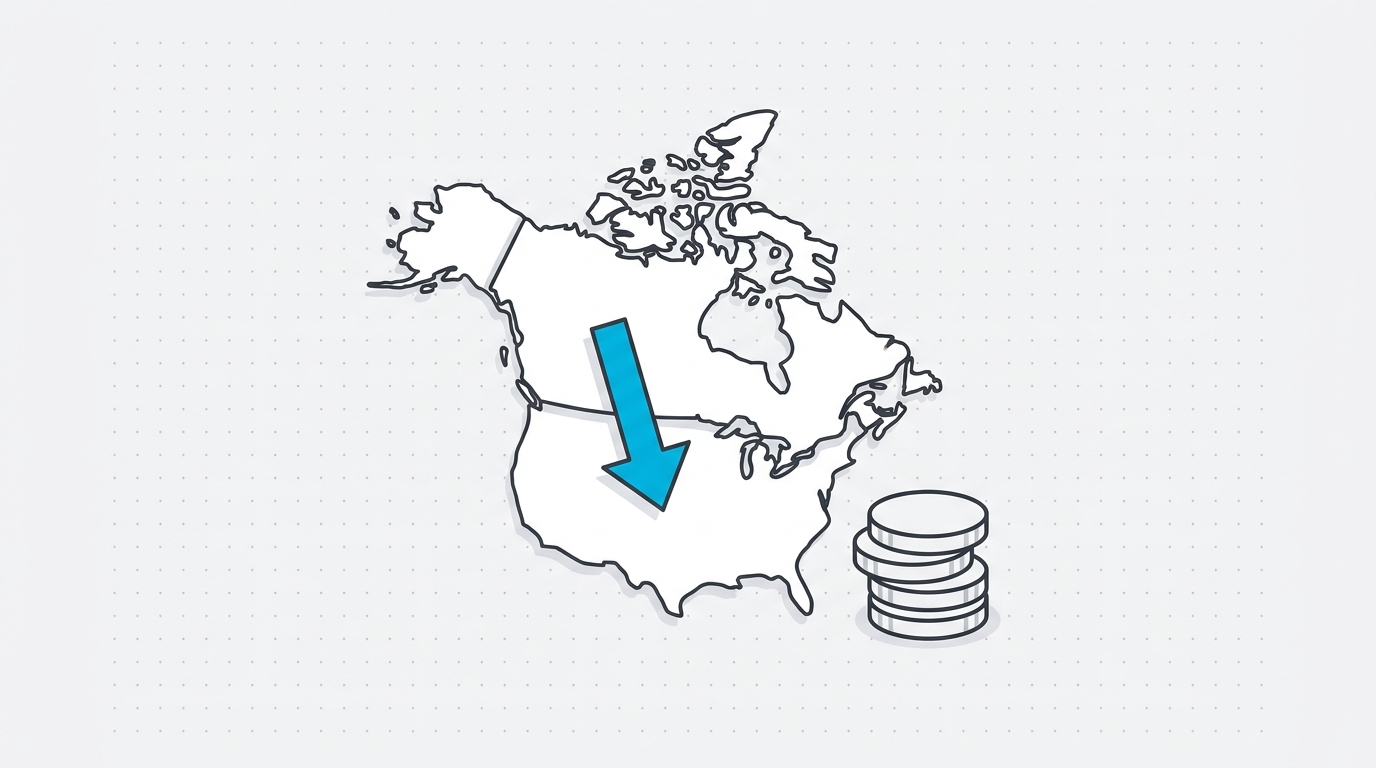
The news hook is real, but it is easy to misread. The ACHR News reported that in February, the Supreme Court ruled that Trump could not impose a 10% global import surcharge under the International Emergency Economic Powers Act of 1977, and in its place, the U.S. Trade Representative finalized tariffs under Section 301. Those replacement duties are not small. New tariffs place 10% to 12.5% duties on 60 countries, which could result in increased costs for imported HVAC equipment and components.
The split is worth understanding. A 10% duty applies to economies that adopted, or committed to adopt, an effective forced-labor import prohibition, such as Canada, Mexico, and the U.K., while 12.5% applies to economies that haven't done so, including China, the EU, and Japan. NPR framed the scale plainly: the United States will slap taxes of 10% to 12.5% on imports from 60 countries accounting for 99% of U.S. imports.
But the ruling did not clear the field. The Supreme Court decision did not overturn duties assessed by CBP under Section 232 (steel and aluminum derivatives, auto parts) or Section 301 (goods from China). For HVAC, that distinction is everything, because the metal duties are the ones that hurt.
Why Section 232 Is the Tariff That Really Hits HVAC
HVAC is a metals business. Compressors, coils, cabinets, heat exchangers and line sets are steel, aluminum and copper, and Section 232 sits directly on those metals. As Thomson Reuters put it, Section 232 tariffs are 50% for most countries on steel and aluminum and 25% on copper, and exposure extends well beyond raw materials to finished goods containing those metals, including industrial machinery and HVAC equipment.
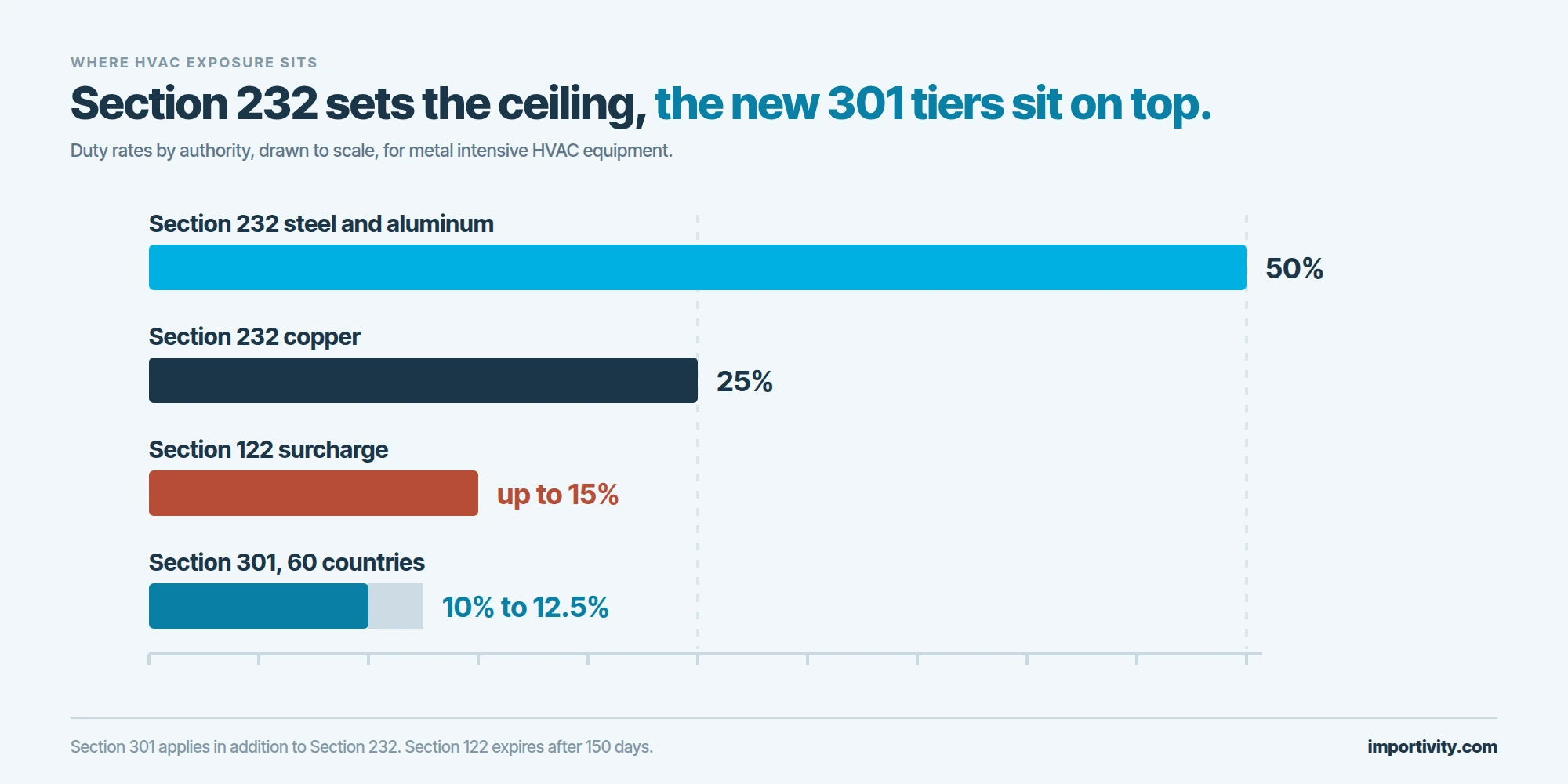
There is a structural change that made this worse. Trade coverage of the ruling's aftermath noted that on April 6, 2026, the administration restructured Section 232 so that tariffs now apply to the full customs value of imported derivative products rather than only the metal content value, and because HVAC equipment is extremely metal-intensive, the effective rate on compressors, coils, cabinets, heat exchangers, and line sets went up, not down.
Copper deserves special attention. For HVACR, that is a direct hit, because copper tubing runs through virtually every refrigerant circuit in the industry. If you build refrigerant circuits, you are paying a copper tariff whether the finished unit ships from China, Mexico or Thailand, because Section 232 follows the metal content, not the assembly point.
The Three Tariff Authorities You Now Have to Track
Post-ruling, HVAC importers are juggling three overlapping tariff regimes, and they stack. A duty under one authority does not cancel a duty under another. The table below summarizes what each authority covers and how stable it is.
| Authority | What it covers for HVAC | Typical rate | Stability |
|---|---|---|---|
| Section 232 | Steel, aluminum, copper content in components and finished equipment | 50% steel/aluminum, 25% copper | Durable, low litigation risk |
| Section 301 | China-origin goods; new 10–12.5% on 60 countries | 10% to 12.5% (plus legacy China rates) | In effect, effective July 24 |
| Section 122 | Broad surcharge bridge on goods not covered by 232/301 | Up to 15% | 150-day sunset, contested in court |
The stacking matters when you model cost. HARDI's tariff guidance is explicit that the applicable Section 301 tariff rate applies in addition to any Section 232 and/or Section 122 duties. And Section 122 is the least reliable leg of the stool. Legal analysts note that Section 122 of the 1974 Trade Act allows import surcharges of up to 15% without a predicate investigation, but tariffs imposed under this provision expire after 150 days unless Congress votes to extend them. A federal trade court has already moved against the replacement surcharge, so treat any 122 line item in your model as temporary.
Watch the litigation calendar
The refund question is still open. HARDI notes that following the Supreme Court's ruling that IEEPA does not authorize broad-based tariff authority, questions have emerged regarding potential refunds of duties previously collected, but the Administration has taken steps that may delay the refund process. If you paid IEEPA-era duties, preserve your rights. See our breakdown of Section 301 tariff refunds and duty drawback for the mechanics.
Step 1: Trace Exposure From the Finished System Down to Components
You cannot model tariffs on "an air conditioner." You have to decompose the unit. Start with your bill of materials and tag each major assembly with three attributes: the material content (steel, aluminum, copper, plastic, electronics), the country of origin of that content, and the HTS code that governs it at import.
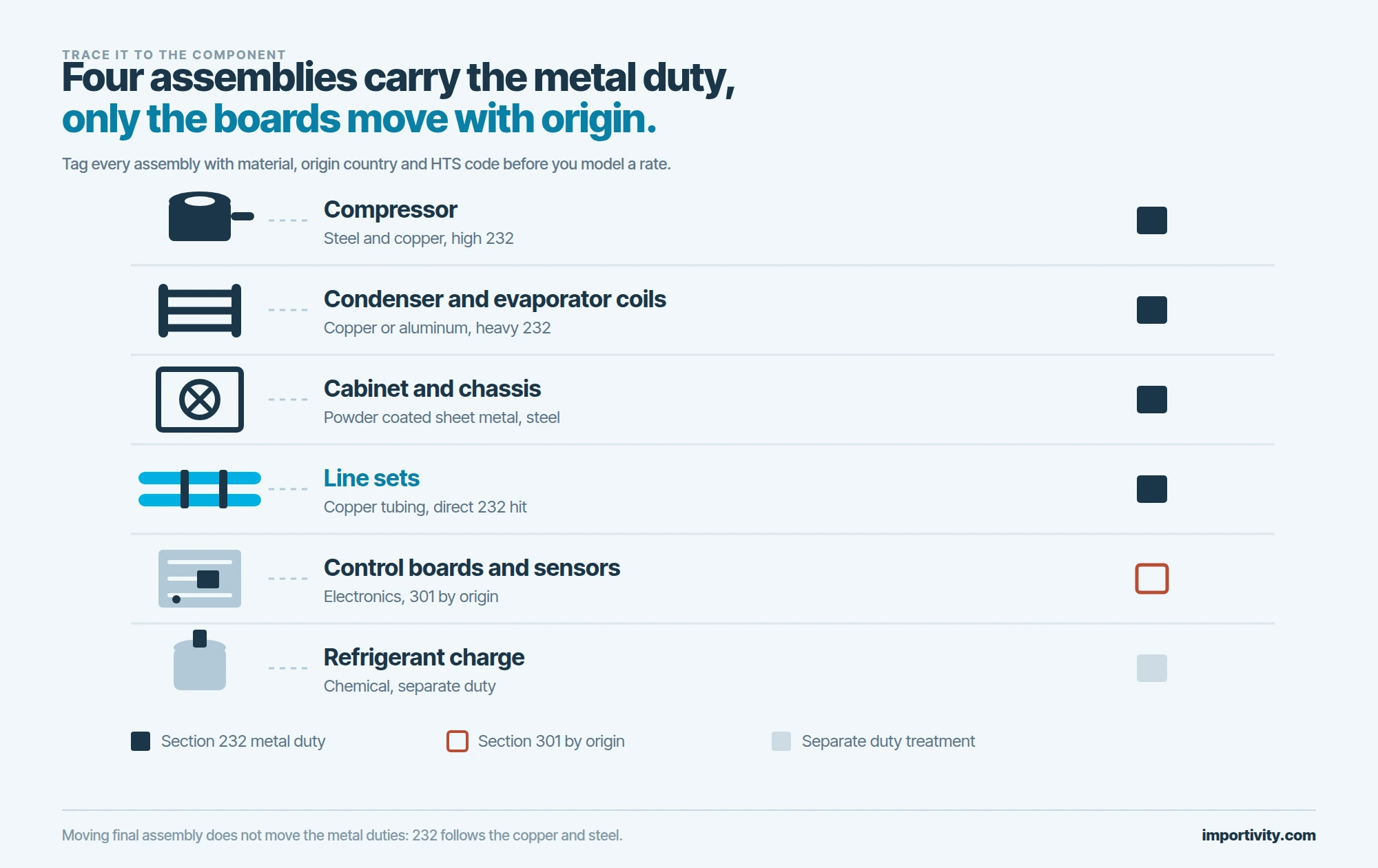
For a typical split system, that decomposition looks like this:
- Compressor — steel and copper, often China or Japan origin, high Section 232 exposure
- Condenser and evaporator coils — copper or aluminum, heavy 232 exposure
- Cabinet and chassis — powder-coated sheet metal, steel 232 exposure
- Line sets — copper tubing, direct copper 232 hit
- Control boards and sensors — electronics, 301 exposure by origin, minimal metal content
- Refrigerant charge — chemical, separate duty treatment
The point of this exercise is that your tariff bill is not one number. It is a weighted sum of component-level exposures, and moving final assembly rarely changes the metal-content duties. For electronics-heavy subassemblies, origin becomes the swing factor, which is why you should verify component origin in your electronics supply chain rather than trusting a supplier's blanket declaration.
Step 2: Get the HTS Codes Right Before You Model Anything
A wrong HTS code means a wrong duty rate, and CBP holds the importer of record responsible. Most air-conditioning machines fall under heading 8415, described as air-conditioning machines comprising a motor-driven fan and elements for changing temperature and humidity, with parts landing under 8415.90. Heat pumps and refrigerating equipment frequently classify under 8418 instead. The distinction turns on capacity, configuration and whether you are importing a complete system or a component.
Real classification is granular. A packaged unit with a reversible heat pump, motor-driven fan and valves in a single chassis was ruled to fall under heading 8415 at the 8-digit level, while condensing and evaporator units have their own subheadings such as 8415.90.8025 and 8415.90.8085. Small distinctions in capacity ratings and self-contained versus split-system configuration change the 10-digit code, and the code determines your rate.
Do not guess. Our guide to HTS codes and customs classification walks through the process, and for high-value programs a binding ruling from CBP removes the ambiguity entirely. Build your model on confirmed codes, not "close enough" ones.
Step 3: Rebuild Your Landed Cost Model by Country and HTS Code
With components tagged and codes confirmed, recalculate landed cost at the SKU level. The core formula does not change, but the duty layer now has three stacked inputs that each vary by origin and code. Your model needs columns for: unit FOB cost, freight, insurance, Section 232 duty (by metal content), Section 301 duty (by origin), any Section 122 surcharge, brokerage, and inland delivery.
The reason to model at this granularity is that the same finished unit can carry very different total duty depending on where its copper, steel and boards come from. A rule the industry keeps relearning: it is difficult to determine how much the new tariffs will affect pricing, as the policy depends on how much each manufacturer's supply chain pulls from those 60 countries. That is precisely why supplier-level and component-level origin data belongs in your model, not a country average.
Use our full walkthrough of how to calculate landed cost to structure the spreadsheet, and remember freight mode matters too. If tariffs have compressed your margin, the difference between FCL and LCL or sea versus air freight can offset part of the hit. Pin down your Incoterms so you know who owns the duty at the border.
Step 4: Decide — Shift Assembly, Swap Suppliers or Redesign the BOM
Once you can see exposure at the component level, three levers are available, and each has real trade-offs.
Shift final assembly
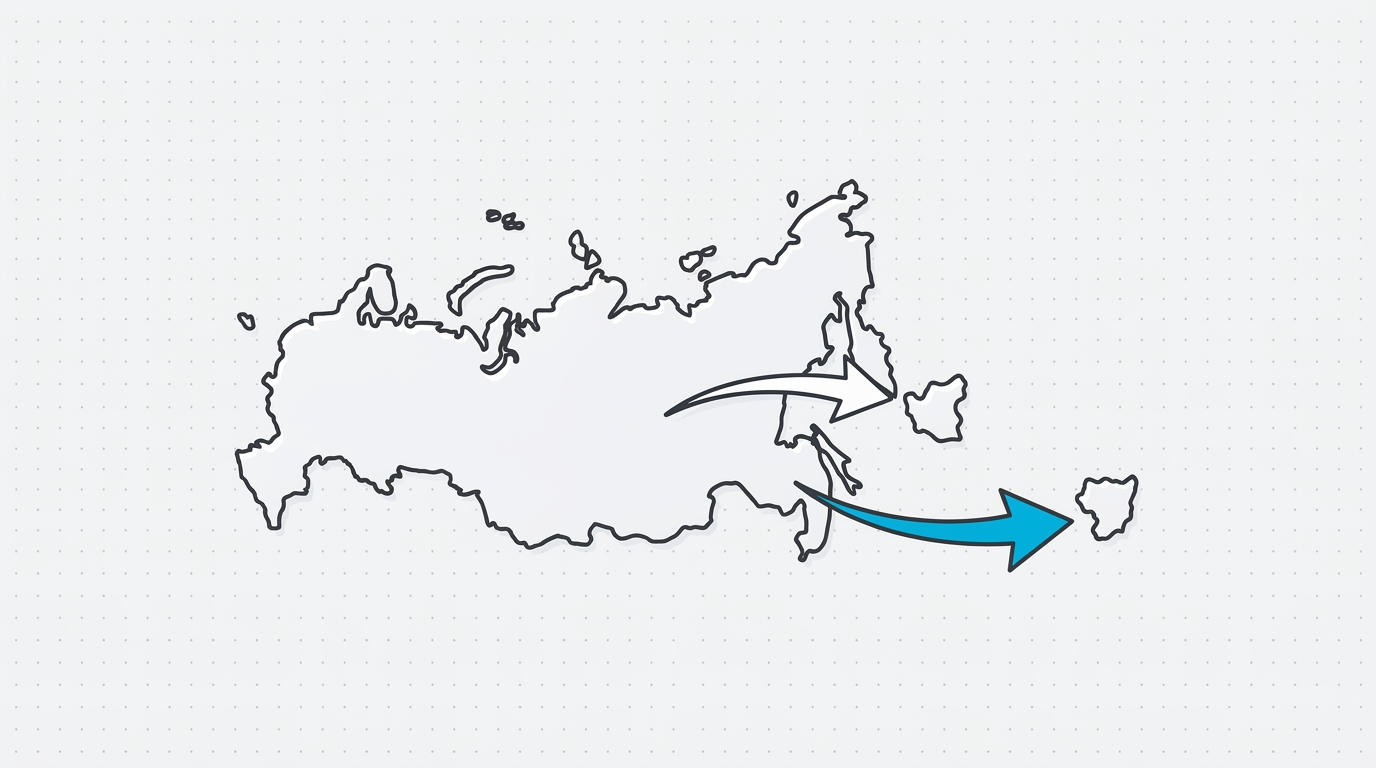
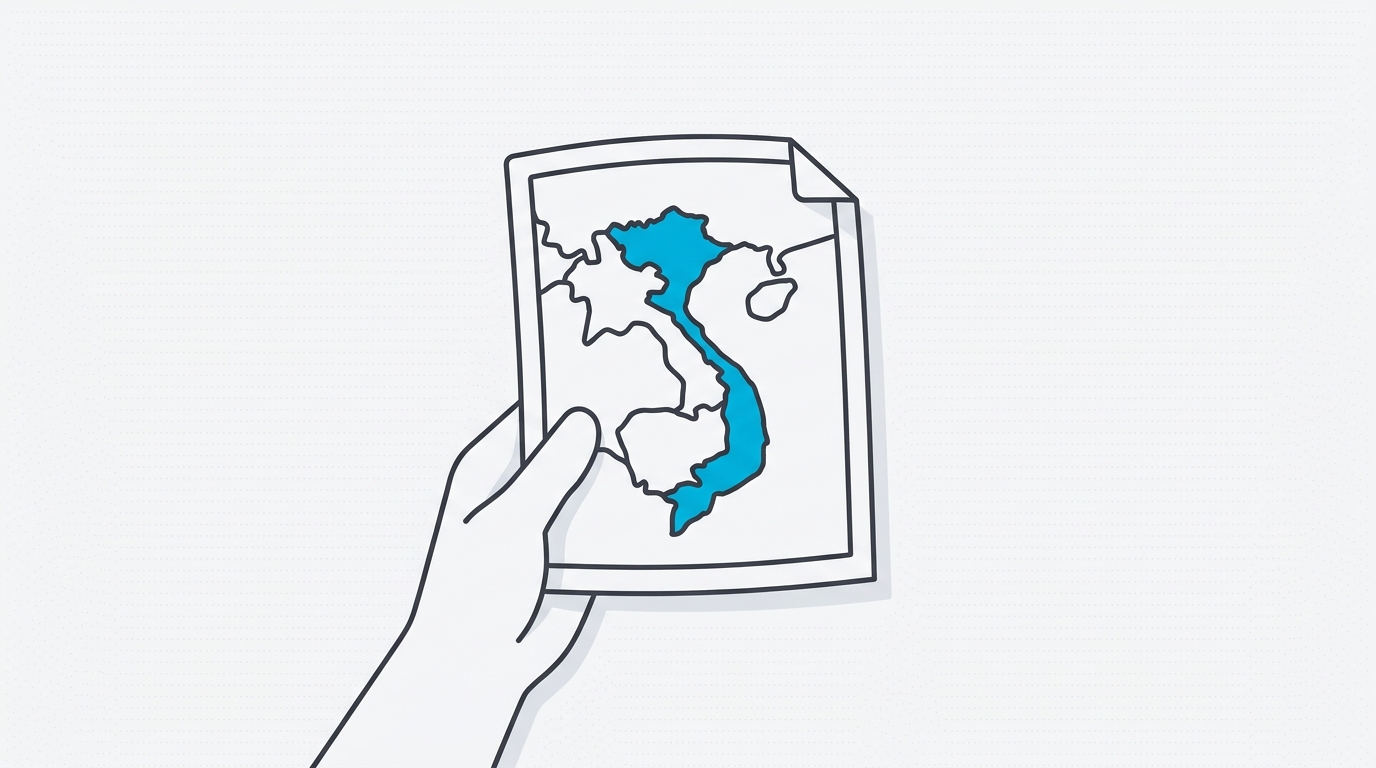
Moving assembly to Vietnam, Mexico or India can lower Section 301 exposure on the finished good, but it does nothing for Section 232 metal duties, which follow the copper and steel content regardless of assembly point. It only works if you genuinely change country of origin under substantial transformation rules. Light "screwdriver" assembly to relabel origin is transshipment and it is illegal, so read our guides on proving Vietnam origin and forced-labor import compliance before you move a line. Note the new 301 tier structure is explicitly tied to forced-labor enforcement, so origin documentation now carries double weight.
Swap suppliers by country
Because the 301 tiers split at 10% versus 12.5% by country, re-sourcing components from a lower-tier country can matter on electronics and non-metal parts. Compare programs with our guides to sourcing from Vietnam, sourcing from India, and India versus China manufacturing. Any new supplier needs a full factory audit and onboarding before you commit volume.
Redesign the bill of materials
The most durable lever is engineering out the exposure. Reducing copper content, substituting aluminum micro-channel coils where performance allows, or consolidating sheet metal parts can cut the metal base that Section 232 taxes. This is slower and requires validation samples, but it survives court rulings and tariff sunsets in a way that paper origin changes do not.
Build a Sourcing Playbook That Survives the Next Ruling
The seesaw of court decisions is not going to stop soon. The practical response is not to chase every headline but to build a process that absorbs change. Keep your BOM, HTS mapping and origin records current, model at the SKU level, and rerun the numbers every time an authority shifts.
If you are re-sourcing components or standing up assembly in a new country, get the fundamentals right first: a tight RFQ, a vetted contract manufacturing partner, and a pre-production sample process to validate any BOM change. Tariff strategy and sourcing strategy are now the same conversation.
For a worked example of what this costs once the duty actually lands, see our case study on scaling a US gum manufacturer through the 2025 tariff debacle, and Source With Jordan for the sourcing decisions behind it.
Frequently Asked Questions
Did the Supreme Court ruling lower HVAC import tariffs?
No. The February 2026 ruling struck down tariffs imposed under IEEPA, but it left Section 232 on steel, aluminum and copper and Section 301 duties fully in place. Because HVAC equipment is metal-intensive, the tariffs that hit the industry hardest were never affected, so most importers saw little or no relief.
Which tariff authority matters most for HVAC importers?
Section 232 on steel, aluminum and copper is the biggest driver, because compressors, coils, cabinets, heat exchangers and line sets are metal-heavy. Since April 2026, Section 232 applies to the full customs value of derivative products rather than just the metal content, which raised effective rates on finished equipment.
How do I find the HTS code for my HVAC product?
Most air-conditioning machines classify under heading 8415, with parts under 8415.90. Heat pumps and refrigerating equipment often fall under 8418. The exact 10-digit code depends on capacity, configuration and whether you import a complete system or a component, so confirm it with a licensed customs broker or a binding ruling.
Can I avoid HVAC tariffs by moving assembly to another country?
Sometimes, but only if you meet substantial transformation rules and the finished good's origin genuinely changes. Routing parts through a third country for light assembly is transshipment and it is illegal. You also cannot escape Section 232 metal duties by relocating assembly, because those follow the steel, aluminum and copper content wherever it originates.
How often should I update my HVAC landed cost model?
Recalculate every time a tariff authority changes, a court issues a ruling, or a Section 232 product list expands, and at minimum quarterly. In the current environment, treat your landed cost model as a living document and rerun it by SKU, HTS code and origin country whenever policy shifts.