














To verify component origin in an electronics supply chain, you need a bill of materials that names every part at the manufacturer-part-number level, a written origin declaration from the supplier for each significant component, and purchase records that let you reconcile what was bought against what was built. The assembly country tells you almost nothing: a board assembled in Taiwan, Korea, or Mexico can be populated with memory, power management, or passive components from anywhere, and the origin that matters for duties and restrictions is the component's own, not the address on the finished carton.
This guide is for hardware brands, importers, and sourcing teams buying finished electronics or assembled boards who need component-level traceability. It covers what origin means for a semiconductor, the documents that actually trace one, how to handle parts bought on the open market, and the process to run before you place a production order. If you are earlier in the process, our guide to sourcing electronics overseas covers supplier types, tooling, and certification first.
Why this became urgent in 2026
Two pressures arrived at once. Section 301 investigations opened in March 2026 cover 16 economies and name semiconductors, electronics, and batteries among the target sectors, which means duty exposure now follows components across several of the countries brands moved production to. Separately, reporting in July described lawmakers pushing to bar Chinese-made memory chips from U.S. government supply chains even when the finished product is assembled by an allied manufacturer, on national and economic security grounds.
The common thread is that a finished-goods origin claim is no longer sufficient. Restrictions and duty exposure are being written at the component level, so a supply chain you cannot decompose is a supply chain you cannot price or defend. How the duty side works is covered in Section 301 tariffs explained.
What origin actually means for a chip
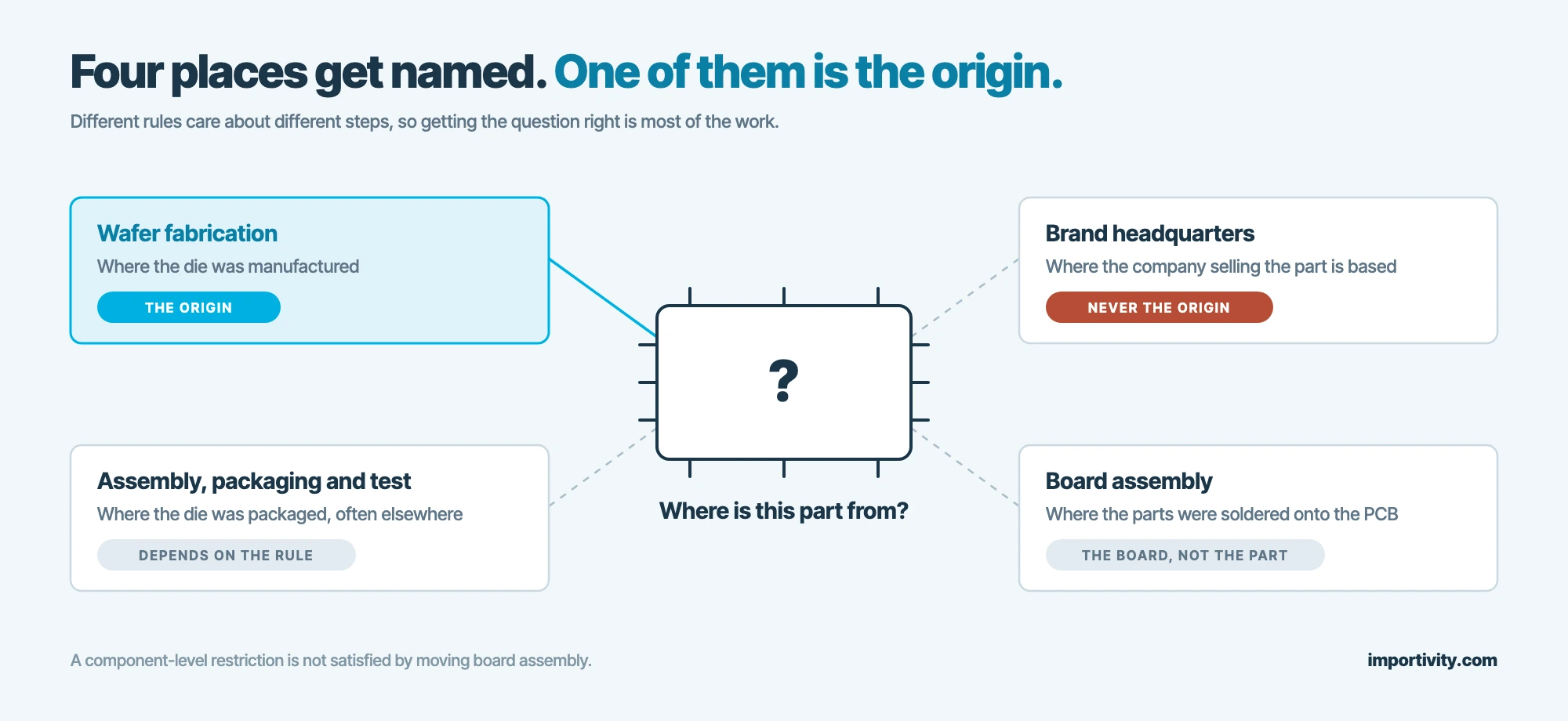
A semiconductor has several plausible origins, and different rules care about different ones. Getting the question right is most of the work.
| Candidate answer | What it refers to | Why it matters |
|---|---|---|
| Wafer fabrication | Where the die was manufactured | Usually the substantive origin for customs and for security restrictions |
| Assembly, packaging, and test | Where the die was packaged into a finished device, often a different country | Sometimes claimed as origin; whether it confers origin depends on the rule applied |
| Brand headquarters | Where the company that sells the part is based | Never origin, and the most common source of false comfort |
| Board assembly | Where components were soldered onto the PCB | Can confer origin on the assembled board while leaving component restrictions intact |
Two conclusions follow. A component-level restriction is not satisfied by moving board assembly, and a duty question about the finished product is not answered by the component's origin alone. You need both layers documented, which is also why classification matters here; see our HTS classification guide.
The documents that actually trace a component
Ask for these by name. Vague requests produce vague answers.
- A full bill of materials at MPN level, with manufacturer name, manufacturer part number, quantity per unit, and the function of each part. A BOM listing "capacitor, 10uF" without a manufacturer is not traceable. Our bill of materials template shows the fields to require.
- The approved vendor list for each line item, including alternates. Alternates are where undocumented origin enters, because a shortage substitution rarely comes with paperwork.
- Supplier origin declarations that state country of wafer fabrication and country of assembly and test, tied to specific part numbers rather than to the company.
- Certificates of conformance from the component maker or authorized distributor, matched to lot and date codes on the parts you actually received.
- Distributor traceability records showing the chain from component manufacturer to your contract manufacturer, with invoices.
- Quantity reconciliation for a sample build: components purchased against units produced. This is the check that catches substitutions nobody disclosed.
Where a component is genuinely sensitive, such as memory, RF, or anything with a security dimension, ask for the fab site rather than the country and expect to sign a confidentiality agreement to get it.
The open-market problem
Parts bought outside authorized distribution are the weakest link in almost every electronics supply chain. During shortages, contract manufacturers buy from brokers to keep a line running, and broker stock carries thin or fabricated traceability along with counterfeit risk. The result is a board you believe is fully documented while a handful of line items came from a source nobody can trace.
Two rules keep this manageable. Require authorized-distribution sourcing as the default in your contract, with written approval needed before any open-market purchase. And require incoming inspection with lot and date-code capture, so that if a part does come from the open market you at least know which units contain it. Testing regimes for questionable parts exist, from documentation review through decapsulation, and they are worth their cost on safety-critical or high-value products. Related failure modes are covered in our quality control work.
A process that works for a small importer
You do not need a corporate compliance department to do this well. You need it done in order, once per product, and repeated when the design changes.
- Freeze the BOM before quoting. A moving BOM makes traceability impossible and makes quotes incomparable.
- Rank parts by risk, not by cost. Memory, processors, power devices, wireless modules, and anything with an export or security dimension go on the short list even when they are cheap.
- Collect declarations for the short list only at first pass. Chasing origin on every passive component stalls the project and adds little.
- Verify two of them independently. Cross-check the declared fab country against the component maker's published site list or ask the distributor to confirm. If both check out, the supplier's process is probably sound. If either fails, widen the audit.
- Lock change control into the purchase order. No substitutions without written approval, disclosure of any open-market purchase, and origin declarations required for replacements.
- Reconcile after the first production run. Compare component purchases against units shipped, and capture date codes from a sample. This is the moment undisclosed substitutions become visible.
- Re-run it annually or on redesign. Component sourcing drifts quietly, especially after an end-of-life notice.
What to do when the answer is a problem
If a sensitive component traces somewhere you cannot accept, you have four options and they differ mostly in lead time. Qualifying an alternate part from a different fab is usually fastest when a drop-in equivalent exists. Dual sourcing the same function from two origins costs more per unit but removes the single point of failure. Designing the part out is the durable answer for a product with a long life. Moving board assembly, on its own, is the option that looks like progress and changes the least, because the component origin travels with the component.
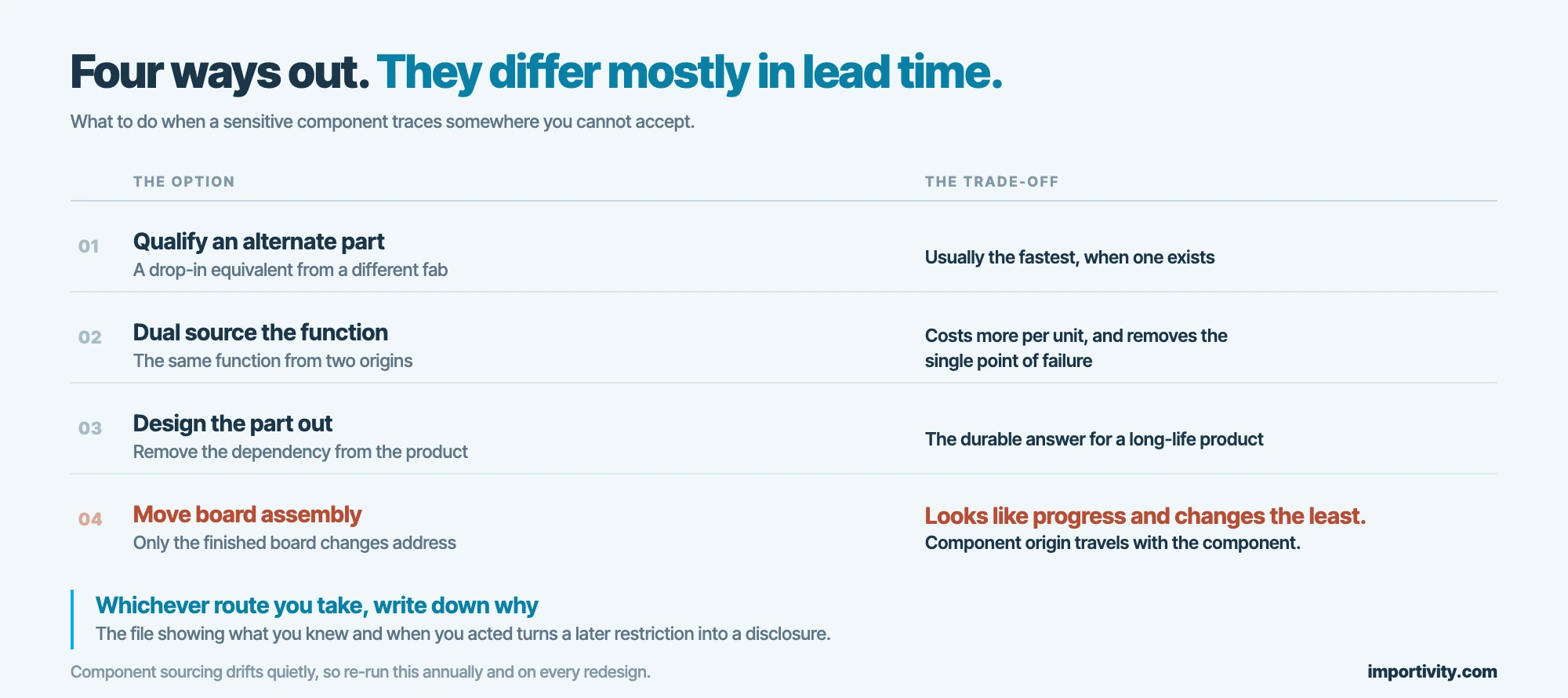
Whichever route you take, document the decision and the evidence behind it. If a restriction later reaches your product, the file showing what you knew and when you acted is the difference between a manageable disclosure and an enforcement problem. The same reasoning applies to labor exposure in the tiers below your supplier, which is covered in forced labor import compliance, and to certification duties in import product compliance.
We film the factory floors we qualify rather than taking a supplier's word for them, and those walkthroughs go out through Source With Jordan.
Frequently Asked Questions
How do I find out where a component was really made?
Ask the supplier for a written origin declaration naming the country of wafer fabrication and the country of assembly and test for that specific manufacturer part number, then cross-check it against the component maker's published site information or the authorized distributor. Match lot and date codes on received parts to the certificates you were given.
Does the country of board assembly determine the origin of my product?
It can determine the origin of the assembled board for customs purposes, but it does not change the origin of the components on it. Component-level restrictions and duty exposure follow the component, so both layers need documenting separately.
What if my contract manufacturer buys parts on the open market?
Treat it as a documented exception rather than a routine. Require authorized distribution by default, written approval before any broker purchase, and incoming inspection that captures lot and date codes so you know which units are affected. Open-market stock carries both traceability gaps and counterfeit risk.
Which components should I trace first?
Rank by risk rather than by cost: memory, processors, power devices, wireless and RF modules, and anything with an export control or security dimension. Chasing origin on every passive component first is how traceability projects stall before they cover what matters.
Can I be liable if a supplier misstates component origin?
Yes. As importer of record you are responsible for the accuracy of the entry, including origin. Supplier declarations and contractual remedies help you recover losses, but they do not transfer the liability, which is why independent verification on high-risk parts is worth the effort.